
Set up Deceased Check
Learn how to set up Socure Deceased Check in the RiskOS™ Dashboard to confirm deceased status.
Before you start
Make sure you have the following:
- Your account owner or administrator can enable this for you. If you're unsure who to contact, contact support for assistance.
- If this is your first time working with workflows, review the Workflow overview to understand inputs, enrichments, routing logic, and decisions.
How it works
Socure Deceased Check evaluates submitted identity inputs to assess whether an identity may be associated with a deceased individual.
Deceased Check:
- Evaluates identity attributes such as name, date of birth, and national ID
- Returns structured signals indicating potential deceased status
Note:
Deceased Check is available for U.S. identities only.
How Deceased Check fits into a workflow
In RiskOS™, workflows are built by connecting reusable components. Deceased Check is added as an Enrichment step.
Once the enrichment runs, its outputs are available to downstream workflow components, including:
- Conditions
- Decision rules
- Rule score cards
- Manual review steps
- Final decisions
For more detail on these components, see Workflow Steps.
Execution flow in RiskOS™
Deceased Check runs synchronously as part of a RiskOS™ workflow. There is no user handoff or pause in execution.
flowchart LR
    A[Input]
    B[Deceased Check]
    C[Routing logic]
    D[Decision]

    A --> B --> C --> D
At a high level, the execution flow looks like this:
-
Input
You call the Evaluation API with identity attributes. -
Deceased Check enrichment
RiskOS™ evaluates the inputs against available deceased records and returns structured signals. -
Routing logic
The workflow evaluates deceased indicators and reason codes. -
Decision
The workflow returns a final outcome (for example, Accept, Review, or Reject).
Workflow components used by Deceased Check
Deceased Check uses a subset of standard RiskOS™ workflow components.
| Component | Purpose | Typical input | Output / What to use next |
|---|---|---|---|
| Input | Start an evaluation | Name, DOB, national ID | Workflow execution begins |
| Enrichment | Check deceased indicators | — | Deceased signals, reason codes |
| Condition | Branch based on signals | Deceased Check outputs | Route to appropriate path |
| Decision Rule / Score Card | Apply policy logic | Deceased Check signals | Pass/fail or escalation |
| Decision | Emit final outcome | Routed value | Accept / Review / Reject |
Configure Deceased Check
Configure inputs
Common inputs include:
- Name
- Date of birth
- National ID (full or partial, where permitted)
Ensure inputs are correctly formatted before submission. Exact requirements may vary by workflow configuration.
Add Deceased Check to a workflow
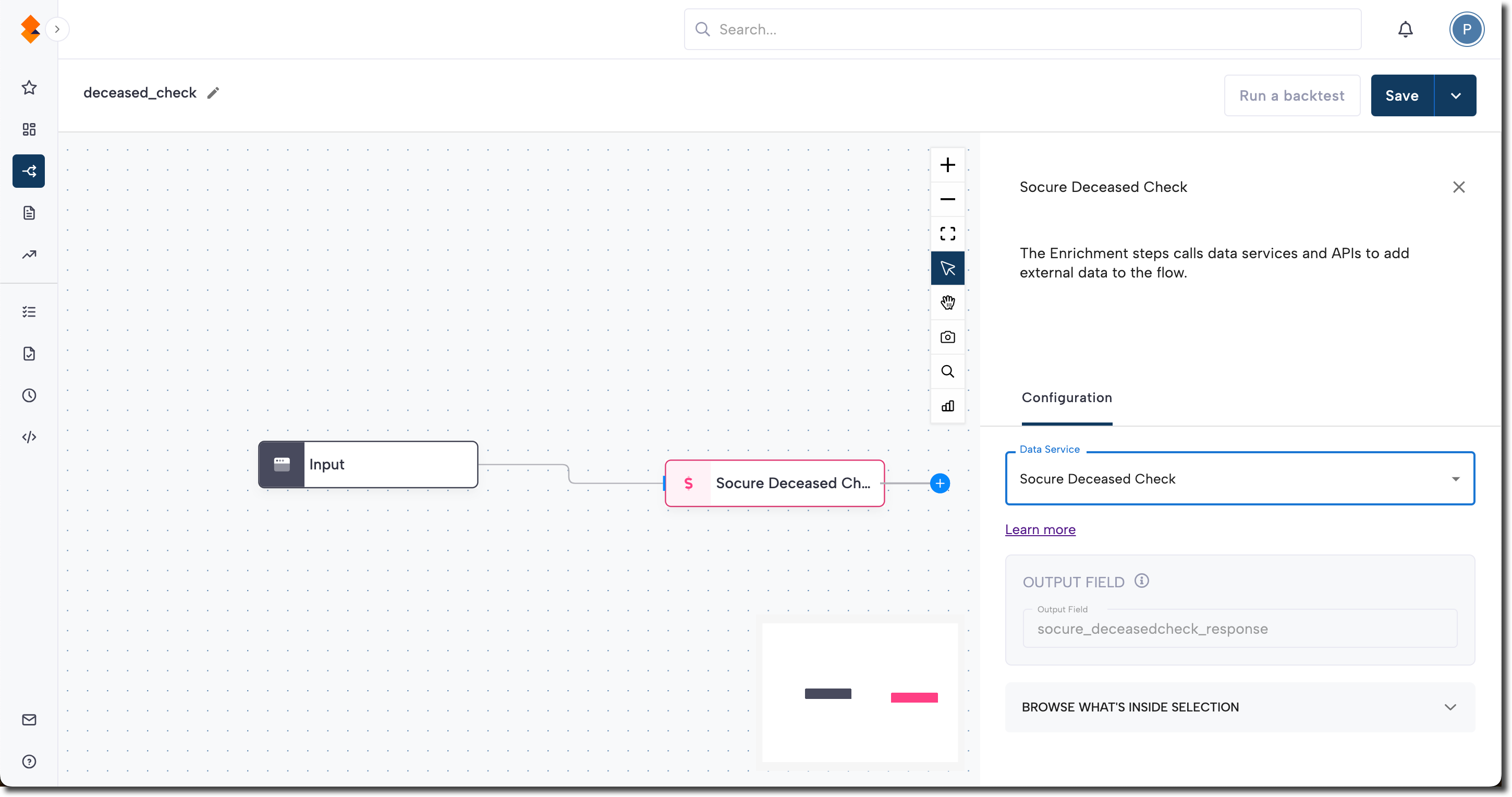
- In the RiskOS™ Dashboard, go to Workflows and create a new workflow or open an existing one.
- On the workflow canvas, select the plus (+) icon.
- Add an Enrichment step and select Socure Deceased Check.
Configure routing and decisions
Deceased Check returns signals that indicate whether an identity may be associated with a deceased individual.
Common routing strategies include:
- Referring cases for additional review
- Applying step-up verification
- Allowing the workflow to proceed when no deceased indicators are present
Definitions and detailed interpretation of returned signals are available in the RiskOS™ Dashboard.
Save and publish
Once your workflow is configured, publish it to go live.
Workflow testing checklist
Use this checklist to confirm accuracy, resilience, and completeness before going live.
R907 or R909) are routed appropriately.
Updated about 19 hours ago