

Set up Email Risk
Learn how to set up Socure Email Risk in the RiskOS™ Dashboard to assess the fraud risk of email addresses and confirm their link to consumer identities.
Before you start
Make sure you have the following:
- Your account owner or administrator can enable this for you. If you're unsure who to contact, contact support for assistance.
- If this is your first time working with workflows, review the Workflow overview to understand inputs, enrichments, routing logic, and decisions.
How it works
Socure Email Risk evaluates an email address and returns signals that help assess email-related fraud risk and identity consistency.
Email Risk returns:
- Email Risk Score: Indicates the relative risk associated with an email address.
- Name-Email Correlation: Indicates how strongly an email aligns with the individual’s name.
These signals can be used across onboarding, authentication, profile updates, and higher-risk transactions to support fraud prevention and trust decisions.
How Email Risk fits into a workflow
In RiskOS™, workflows are built by connecting reusable components. Email Risk is added as an Enrichment step.
Once the enrichment runs, its outputs are available to downstream workflow components, including:
- Conditions
- Decision rules
- Rule score cards
- Manual review steps
- Final decisions
For more detail on these components, see Workflow Steps.
Execution flow in RiskOS™
Email Risk runs synchronously as part of a RiskOS™ workflow. There is no user handoff or pause in execution.
flowchart LR
    A[Input]
    B[Email Risk]
    C[Routing logic]
    D[Decision]

    A --> B --> C --> D
At a high level, the execution flow looks like this:
-
Input
You call the Evaluation API with an email address and supporting identity data. -
Email Risk enrichment
RiskOS™ evaluates the email address and returns risk scores, correlations, and reason codes. -
Routing logic
The workflow evaluates Email Risk outputs. -
Decision
The workflow returns a final outcome (for example, Accept, Review, or Reject).
Workflow components used by Email Risk
Email Risk uses a subset of standard RiskOS™ workflow components.
| Component | Purpose | Typical input | Output / What to use next |
|---|---|---|---|
| Input | Start an evaluation | Email address, country, supporting identity data | Workflow execution begins |
| Enrichment | Evaluate email risk | — | Risk score, correlation, reason codes |
| Condition | Branch based on risk or signals | Email risk signals | Route to appropriate path |
| Decision Rule / Score Card | Apply policy or scoring logic | Email risk signals | Pass/fail or cumulative risk classification |
| Decision | Emit final outcome | Routed value | Accept / Review / Reject |
Configure Email Risk
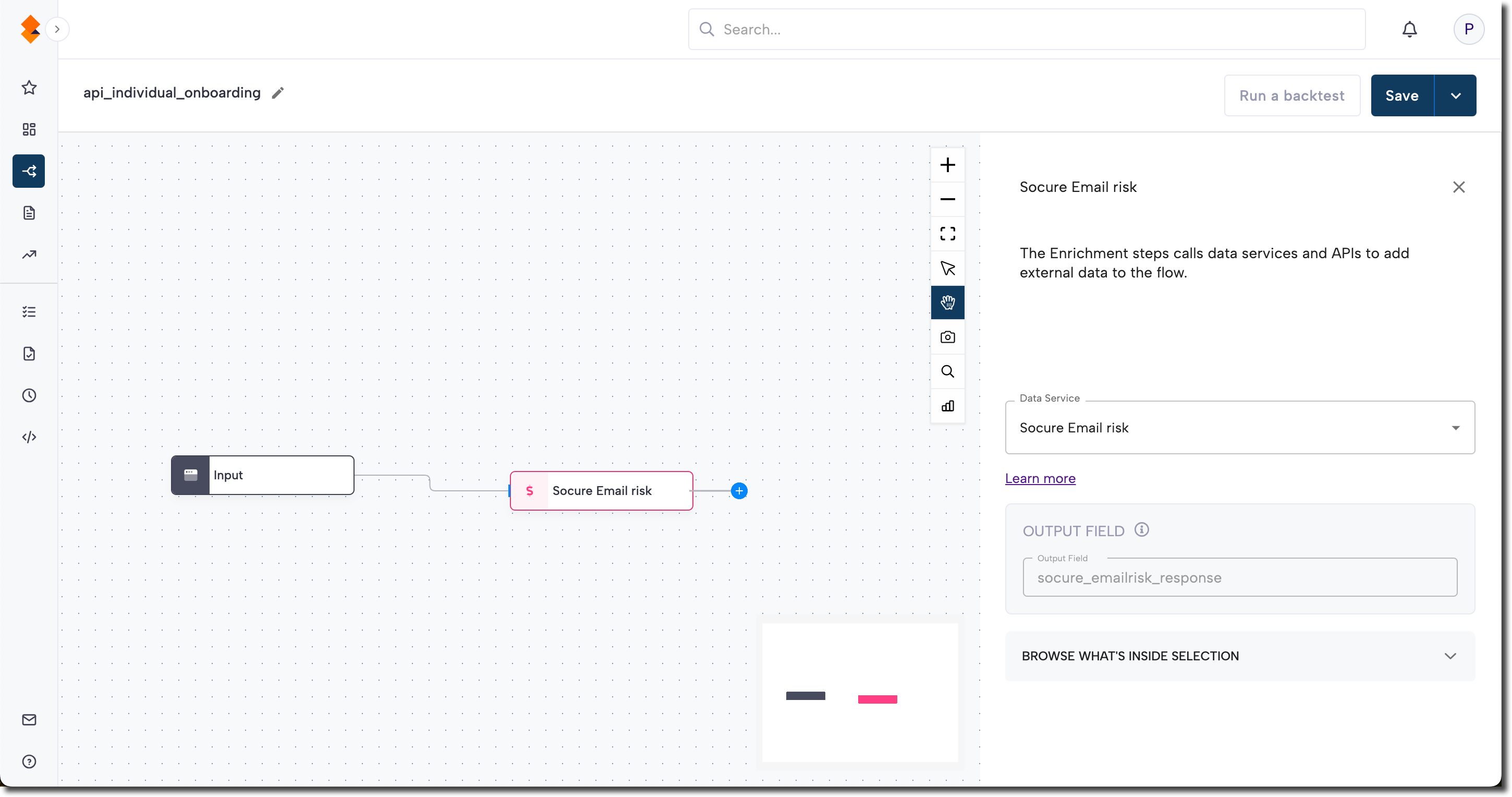
Add Email Risk to a workflow
- In the RiskOS™ Dashboard, go to Workflows and create a new workflow or open an existing one.
- On the workflow canvas, select the plus (+) icon.
- Add an Enrichment step and select Email Risk.
After the enrichment is added, its outputs can be referenced by downstream workflow logic.
Configure inputs and routing
Email Risk evaluates the email address and supporting identity information provided by your workflow. Providing complete and accurate inputs improves overall signal quality.
Required input
data.individual.email
Optional supporting inputs
When available, include:
data.individual.given_namedata.individual.family_namedata.individual.address.line_1data.individual.address.localitydata.individual.address.countrydata.individual.address.major_admin_divisiondata.individual.address.postal_code
Omitting optional fields will not prevent execution, but may limit certain outputs or reduce confidence.
You can use Email Risk outputs—including scores, correlations, and reason codes—to configure routing logic that supports outcomes such as Accept, Review, or Reject.
Routing strategies should align with your organization’s fraud policy and risk tolerance.
Save and publish
Once your workflow is configured, publish it to go live.
Workflow testing checklist
Use this checklist to confirm accuracy, resilience, and completeness of the workflow before going live.
Updated about 19 hours ago